Auto QC for Scale and Image Accuracy
A high-level architecture for image accuracy at production scale: controlled intake, garment context, intent-guided localisation, a multi-perspective Tribunal, focused human review, and governed improvement.
By Vikash Ranjan, Co-Founder & Chief Technical Officer · Published 2026-08-19 · Updated 2026-08-20 · 10 min read
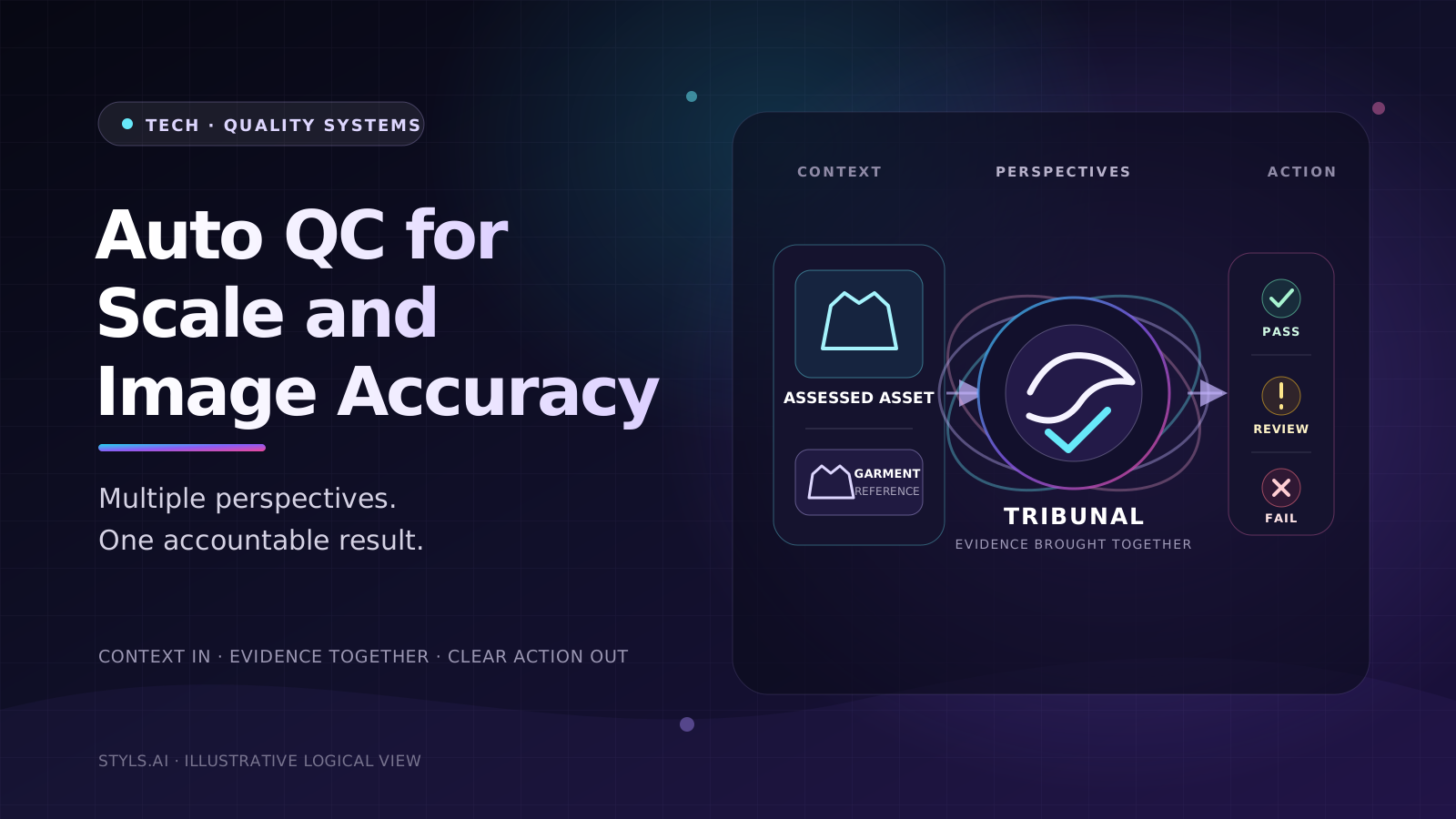
Image accuracy starts with context
A fashion image can look polished while changing a silhouette, losing a construction detail or drifting from the intended garment. A collar sits a centimetre high in an otherwise flawless photograph. An olive jacket is rendered against a forest-green reference. Visual appeal alone is therefore not enough to establish whether an output is accurate.
Here, image accuracy means faithfulness to the required garment reference image and stated production intent. It is not a claim of pixel-perfect correspondence or guaranteed correctness.
We begin with the asset being assessed, its required garment reference image and the available intent or approved quality guidance. Together, those inputs provide the context needed to turn visual evidence into a report that creative, production and quality teams can understand and act on.
The thousandth image deserves the same standard as the first
Human attention is finite. That becomes especially visible when teams review thousands of visually similar fashion images, a hundred navy blazers in sequence, under real production deadlines. Subtle changes become harder to notice across a long queue, because sustained concentration is a limited resource and the four-hundredth near-identical image costs more of it than the fourth. Nothing about that reflects on how much reviewers care.
Image accuracy at this scale is a systems problem as well as a people problem. Repeatable coverage applies a consistent baseline, while review-worthy cases reserve human judgement for ambiguity, context and consequence.
At scale, attention is the scarce resource, and deciding where it goes is the problem to solve.
The architecture at a glance
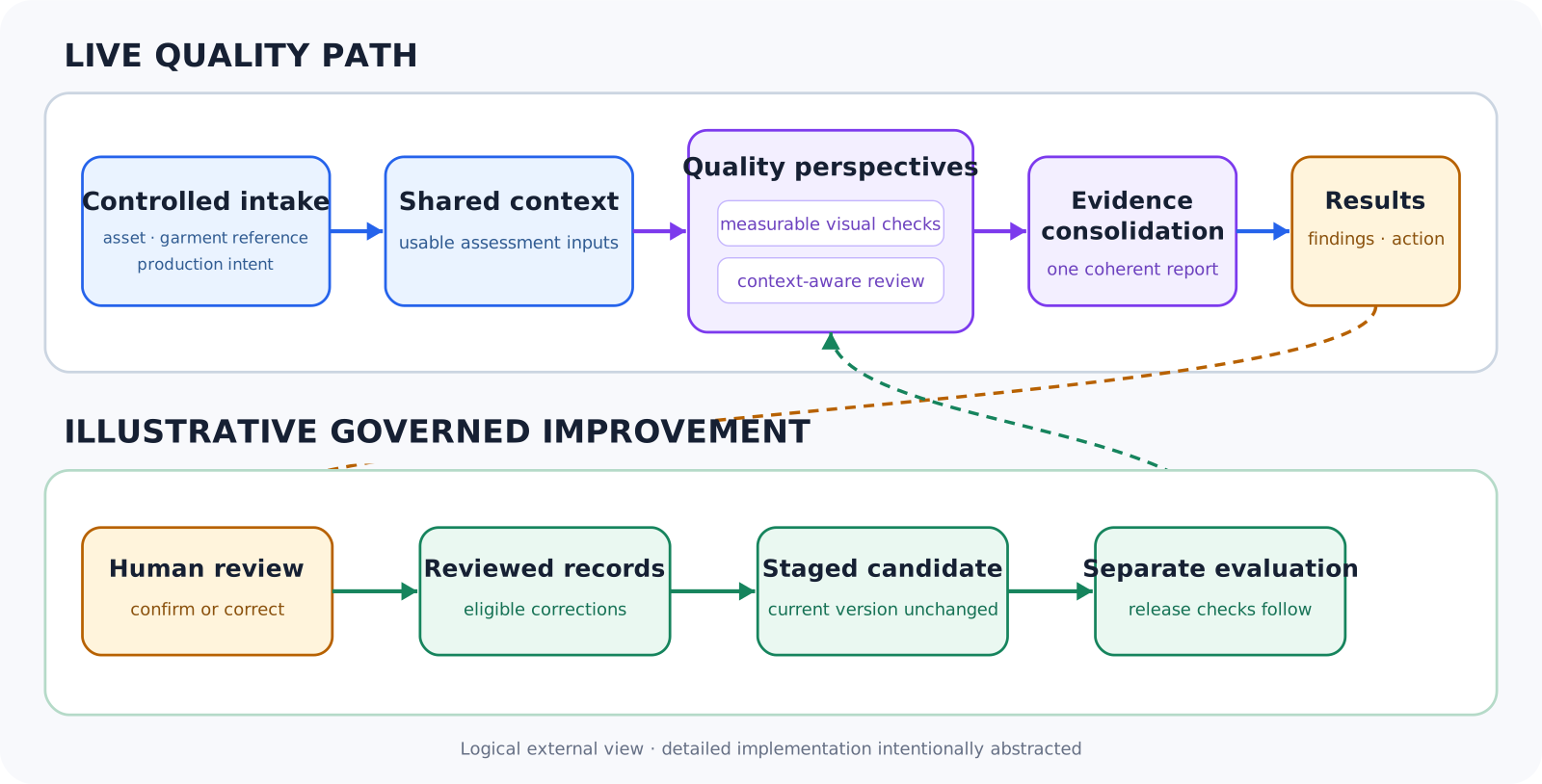
The logical architecture has two connected paths. The live assessment path moves from controlled intake to a structured result. The illustrative governed-improvement path shows how eligible reviewed corrections, a corrected sleeve length or a rejected colourway, may support later learning and evaluation without allowing training alone to replace the current version.
Controlled intake keeps input problems separate from quality decisions
Every assessment begins by checking that the asset and its required garment reference image are present and usable. Available production intent travels with them as assessment context. An incomplete request is identified as an input problem. A missing reference must never come back looking like a garment that failed review.
The Tribunal brings together separate quality perspectives
Fashion quality is several questions at once. An image may remain visually plausible while drifting from its garment reference, missing production intent or containing a local issue that deserves review. The Tribunal keeps complementary responsibilities separate before consolidating the available evidence.
This reduces dependence on any one signal. It also makes disagreement useful: uncertainty or incomplete coverage can remain visible for review instead of disappearing behind a confident-looking answer.
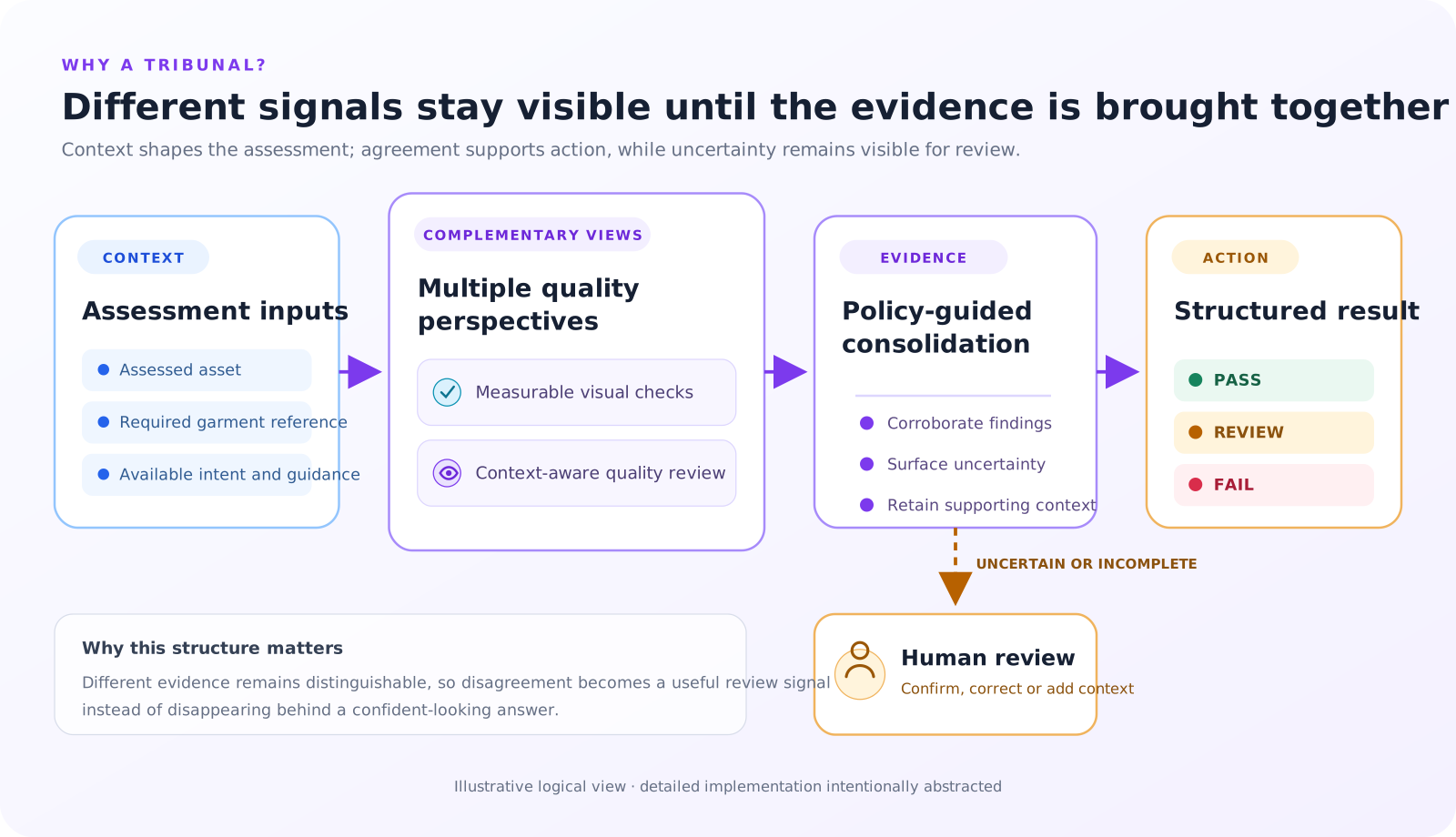
Measurable visual checks provide repeatable coverage and surface consistent, review-worthy visual signals. Context-aware assessment relates the asset to its required garment reference image and stated production intent — the perspective that notices a belt on a garment the styling sheet said would have none. We then bring the separate findings together into one structured report without hiding incomplete coverage. Focused human review applies judgement where ambiguity or downstream consequence warrants attention.
The Tribunal forms the initial evidence-backed report. Human review sits around that report as a governance layer; it is not a promise that every asset is manually reviewed by every role.
Evidence becomes an actionable result
Evidence is consolidated into structured findings rather than a bare score. A finding can explain the issue, retain its supporting context and identify the affected garment or region when appropriate.
The report communicates a policy-guided Pass, Review or Fail disposition. The middle state is deliberate: ambiguous or incomplete cases can retain their evidence without being forced into either success or failure.
A Review outcome means the system found something it could not settle, and said so. We count that as the system working.
Localisation makes findings actionable
The required garment reference image and stated production intent help focus attention on the garment or region that matters to the request. That context can connect a quality concern to the relevant part of the image instead of leaving a team with only a general warning. A reviewer sees which part of the garment to look at, rather than a single number with nothing behind it.
Useful localisation explains what needs attention, where it appears and why it matters to the intended result. We cannot always place a flaw in the left cuff rather than somewhere in the sleeve, and pointing at a region is a different thing from being right about it.
People govern ambiguous outcomes
Review-worthy cases retain their supporting context so a person can confirm the report, correct it or add a better explanation, such as noting that a hem reading short is this season's cut. Peer review strengthens operational consistency, while customer-confirmed corrections preserve the business context behind the desired outcome.
Internal peers and external customers operate under different, equally legitimate responsibilities. Internal peers must make consistent decisions while keeping production moving within delivery commitments. Delivery pressure can favour throughput and make a borderline case easier to pass internally, at six on a Friday with a slightly washed-out grey marl in front of you. That pressure is structural. It says nothing about reviewer care or expertise.
External customers review from the point of acceptance. They are incentivised to protect the highest acceptable quality bar required for their brand and downstream use, so they may reject an output, a colourway a shade off the swatch, that was reasonable to accept inside the production workflow. Neither perspective is better; preserving both gives the quality process more context than treating every review as interchangeable.
Feedback, training, evaluation and release stay separate
Peer and customer feedback retains its source and context. Raw reports do not train directly; eligible reviewed corrections may be curated for a governed improvement process. We keep provenance as part of the record, so unlike review situations are not mistaken for interchangeable labels.
The governing design separates learning examples from evaluation material. A model trained on the same collar errors it is later measured on will report that it has solved collars. Improvement work may create a staged candidate, but training does not authorise promotion and does not by itself change the version used for assessment.
Separate evaluation and release gates govern whether a staged candidate may become current. A candidate that does not qualify leaves the current version active. A quality system you cannot roll back after a bad week of collars is a quality system nobody will trust. Promotion history and rollback remain explicit governance concerns, while the detailed criteria and operating mechanics are intentionally outside this public view.
Monitoring keeps the quality loop visible
Aggregated monitoring shows whether outcome patterns, review demand or recurring issue themes change over time, such as collar findings rising across a season. It helps quality teams identify where investigation may be useful without turning any single dashboard signal into an automatic judgement about an asset, reviewer or candidate.
Monitoring informs evaluation and governance; it does not replace supporting evidence, human review or controlled release decisions. Detailed monitoring configuration is deliberately not part of this public view.
The objective and the limit
Repeatable coverage helps surface recurring issues earlier, while focused review gives ambiguous cases the attention they deserve. A wrong colourway caught before delivery is generally less disruptive than the same colourway caught after acceptance, and a structured finding is easier to act on than an unexplained score.
The same loop applies away from imagery. A generated tech pack can have every field populated, measurements internally consistent and house formatting exactly right, and still specify a flatlock seam on a fabric that needs an overlock. Every structural check passes, and the error surfaces weeks later when a sample comes back from a factory that built precisely what it was told to build. A well-formed artefact carrying a violated intent behaves the same way whether it is an image, a tech pack or a size chart.
The intended outcome is fewer preventable quality incidents and better use of human attention. No review structure can promise zero defects, remove every ambiguity or guarantee that every decision will be correct.
The takeaway
Auto QC for scale and image accuracy is a governed quality loop: garment context enters through controlled intake, separate perspectives produce evidence, localisation helps make findings actionable, people resolve ambiguity, and improvement remains separate from release. The architecture matters because dependable quality control is as much about attention, boundaries and accountable decisions as it is about visual intelligence.
Which leaves the harder half. Where you work, who owns the definition of correct — and who carries it when something clears the bar that should not have?